Wellness Real Estate in Dubai
Wellness Real Estate in Dubai: Why Health, Nature and Lifestyle Are Becoming Investment Drivers
For decades, real estate value was largely associated with three things:
Location. Size. Price.
Those factors still matter.
But residential buyers are increasingly asking a different set of questions.
How much natural light does the home receive?
Is there access to greenery?
Can residents exercise without leaving the community?
Are there quiet spaces?
Is the development designed around families?
Can people socialize easily?
Does the building encourage healthier daily habits?
These questions reflect the rise of wellness real estate.
Wellness real estate is not simply about adding a gym to a residential building.
It represents a broader approach to development where the built environment is designed to support physical health, mental wellbeing, social connection, and quality of life.
Dubai is particularly well positioned for this trend.
The city is investing heavily in future urban planning, green spaces, mobility, public areas, and community infrastructure.
The Dubai 2040 Urban Master Plan, for example, aims to more than double green and recreational areas and create green corridors connecting residential areas, workplaces and service areas.
The plan also places emphasis on accessibility, with an objective of putting 55% of residents within 800 meters of major public transport stations.
These changes matter to real estate.
Because a home is not just a private interior.
It is part of an environment.
And that environment can influence how people live every day.
What Is Wellness Real Estate?
Wellness real estate refers to residential development designed around factors that can support healthier and more balanced lifestyles.
These can include:
- Natural light
- Green spaces
- Walking paths
- Fitness facilities
- Outdoor exercise
- Quiet spaces
- Healthy indoor environments
- Community areas
- Access to nature
- Recreational facilities
- Sustainable design
The concept is broader than traditional luxury.
A luxury building may have expensive materials and impressive finishes.
A wellness-focused building asks a different question:
How does the property make everyday life better?
That difference is important.
Why Wellness Is Becoming More Important
Modern urban lifestyles can be demanding.
People spend long hours working, commuting, using digital devices, and moving between highly developed environments.
As a result, the home increasingly becomes a place of recovery.
Residents want somewhere they can:
- Relax
- Exercise
- Socialize
- Work
- Sleep
- Spend time outdoors
This is changing expectations for residential development.
A swimming pool alone may no longer be enough.
Residents may want a complete ecosystem that supports different aspects of daily life.
Nature as a Residential Asset
One of the simplest elements of wellness design is nature.
Trees.
Gardens.
Landscaping.
Walking paths.
Open spaces.
These features can fundamentally change how a development feels.
A building surrounded by greenery can create a different experience from a building surrounded entirely by hard surfaces.
This is why landscape architecture is becoming increasingly important.
The outdoor environment should not be treated as leftover space.
It can become an integral part of the development.
Dubai’s long-term planning recognizes this relationship.
The Dubai 2040 Urban Master Plan specifically aims to increase green and recreational spaces and develop green corridors connecting different parts of the city.
For developers, this represents a major opportunity.
For investors, it creates another factor to evaluate.
Green Space and Community Identity
Green space can do more than improve appearance.
It can create identity.
A development with a strong central garden, landscaped courtyard, walking route, or outdoor social area can feel different from a collection of buildings surrounded by parking.
This can influence how residents perceive the community.
The best developments use landscape as part of the architecture.
The buildings frame the gardens.
The paths connect different areas.
The amenities open toward shared spaces.
The result is a more integrated environment.
Wellness Is More Than a Gym
The traditional residential gym is changing.
Modern wellness-focused developments may provide:
- Yoga spaces
- Meditation areas
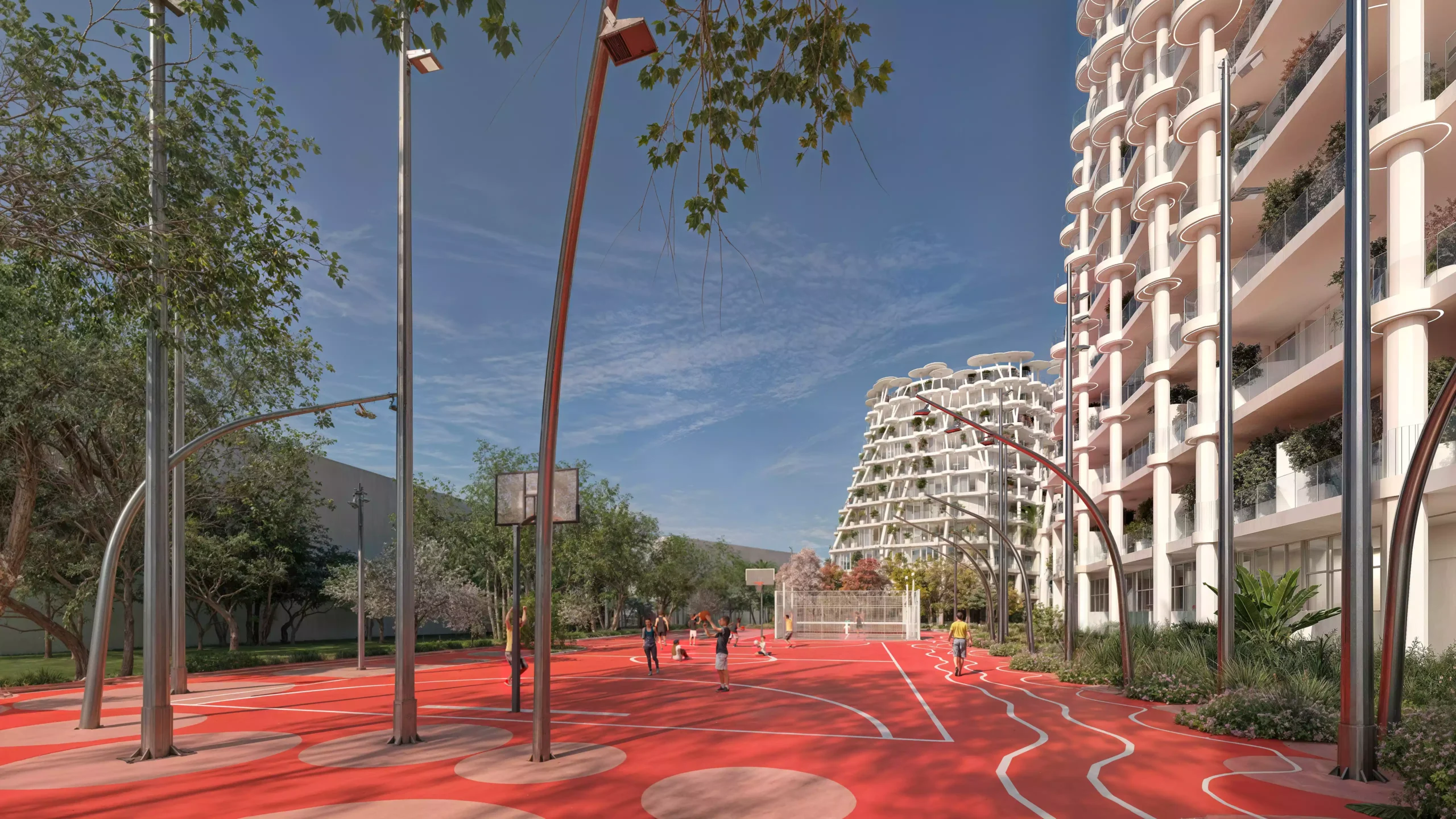
- Running tracks
- Outdoor fitness
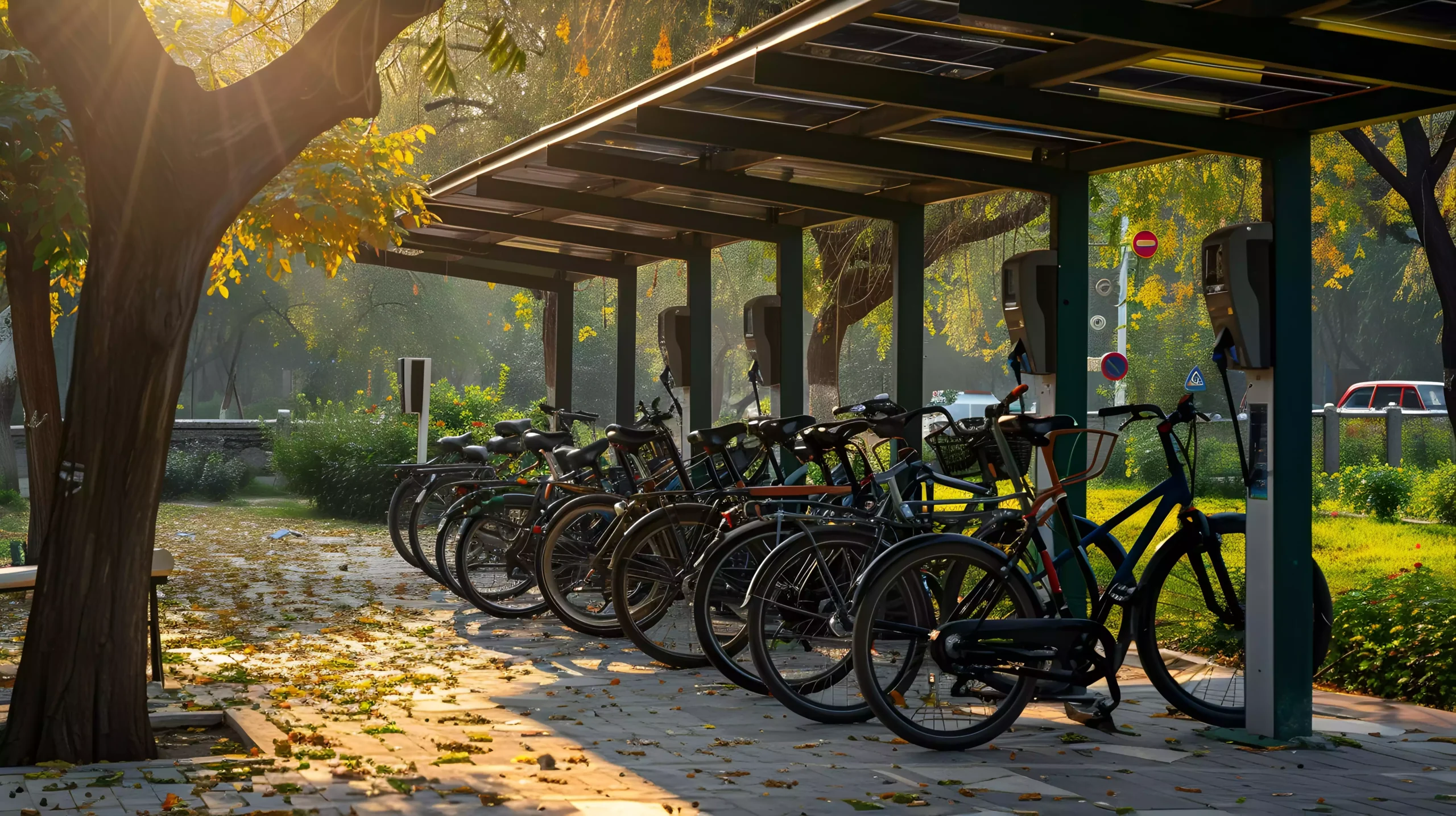
- Cycling facilities
- Recovery areas
- Pools
- Wellness lounges
- Walking routes
The objective is not to force residents to exercise.
It is to make healthy activity easier.
That distinction is important.
If the fitness area is located conveniently within the community, residents are more likely to use it.
If walking paths connect residential buildings to amenities, movement becomes part of daily life.
The environment itself encourages activity.
The Rise of Walkable Residential Communities
Walkability is another major component of wellness.
Residents should not have to enter a car every time they want to:
- Exercise
- Meet a neighbor
- Reach a garden
- Visit an amenity
- Access a social space
Dubai’s 2040 planning framework includes the concept of a “20-minute city,” aiming to improve access to essential services through walking, cycling and sustainable mobility.
This concept has implications for real estate.
A residential community designed around convenience can offer a different lifestyle from a development where every activity requires driving.
For investors, walkability can therefore become part of the property’s value proposition.
Indoor Environmental Quality
Wellness does not stop at the front door.
The quality of the indoor environment matters as well.
This can involve:
- Ventilation
- Lighting
- Temperature
- Acoustics
- Materials
- Air quality
- Natural light
A good residential environment should feel comfortable throughout the day.
Natural light is particularly important.
Large windows and thoughtful orientation can improve the experience of a home without adding another amenity.
This demonstrates a broader principle:
Wellness is often created through design decisions rather than expensive additions.
The Role of Natural Light
Natural light affects how people experience interior spaces.
It can make apartments feel:
- Larger
- Brighter
- More welcoming
- More connected to the outside
The relationship between interior and exterior space therefore becomes important.
Balconies, terraces, large windows, courtyards, and landscaped views can all contribute to this connection.
For buyers, these characteristics should be evaluated during property selection.
Two apartments with the same floor area can feel completely different depending on orientation and access to light.
Quiet Spaces in a Busy City
Dubai is a dynamic city.
But residents also need places to slow down.
Wellness-focused developments can create quieter zones through:
- Landscaped courtyards
- Meditation areas
- Shaded gardens
- Rooftop lounges
- Water features
- Private terraces
These areas can provide a contrast to the energy of the surrounding city.
The goal is not isolation.
It is balance.
A successful residential environment can provide access to activity while also providing places for retreat.
Social Wellness
Wellness is not only physical.
Human connection matters.
Residential developments can encourage social interaction through:
- Community lounges
- Outdoor dining
- Shared gardens
- Children’s areas
- Co-working spaces
- Events
- Recreational facilities
This creates opportunities for residents to interact naturally.
A community should not feel like a collection of isolated apartments.
It should provide opportunities for people to belong.
Family-Oriented Wellness
For families, wellness has an additional dimension.
Parents often evaluate properties based on the environment their children will experience.
They may prioritize:
- Safe outdoor spaces
- Play areas
- Greenery
- Walking routes
- Swimming pools
- Family amenities
- Schools nearby
This creates an important market opportunity.
A wellness-oriented community can appeal not only to individuals seeking fitness, but also to families seeking a healthier environment for everyday life.
Sustainability and Wellness
Wellness and sustainability often overlap.
A development that prioritizes:
- Green spaces
- Efficient energy use
- Water management
- Sustainable materials
- EV infrastructure
- Walkability
can support both environmental and lifestyle objectives.
Dubai’s broader planning strategy is increasingly focused on sustainable development.
The Dubai 2040 framework includes expanded green areas, sustainable mobility, and additional land allocation for education and healthcare facilities.
For developers, this means sustainability is becoming less of an optional marketing feature and more of a long-term planning consideration.
Wellness Real Estate as an Investment Concept
The investment case for wellness real estate should be approached carefully.
Wellness features do not guarantee appreciation.
However, they can contribute to the attractiveness of a property.
A property that offers:
- Good location
- Strong design
- Quality construction
- Green space
- Useful amenities
- Healthy lifestyle features
may appeal to a broader range of residents.
This can potentially support demand.
The important point is that wellness should complement strong fundamentals.
It should not be used as a substitute for them.
The Importance of Location
A wellness-focused building still needs a good location.
Investors should evaluate:
- Transportation
- Employment
- Education
- Healthcare
- Retail
- Recreation
- Connectivity
A beautiful wellness community that is inconveniently located may struggle.
The strongest projects combine wellness with accessibility.
This is consistent with Dubai’s long-term urban strategy, which seeks to integrate residential communities with services and transportation rather than treating them as isolated developments.
HRE Development and Purpose-Driven Residential Design
HRE Development has increasingly incorporated wellness, nature, community, and purpose into its residential concepts.
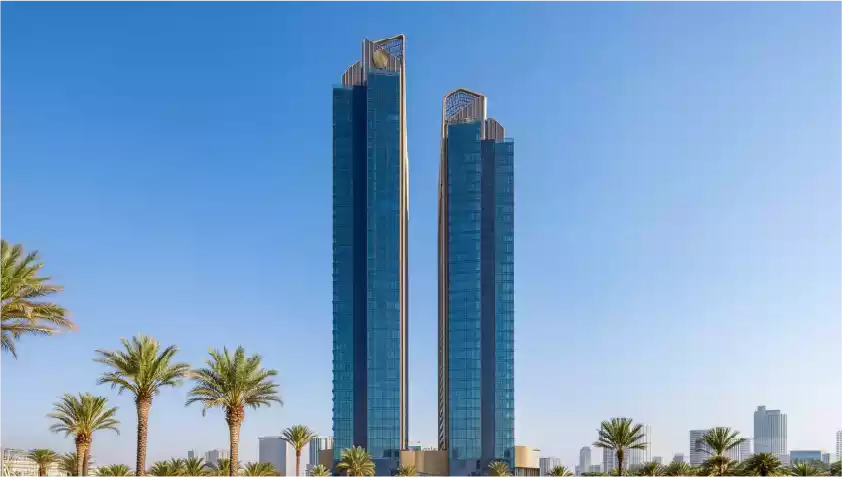
SkyHills Astra, for example, includes a rooftop wellness platform for yoga and meditation, outdoor fitness stations, a running track, community gardens, pools, and co-working facilities. The project is located in Dubai Science Park and also includes EV charging infrastructure and access to Dubai Metro.
This combination is significant because the project does not treat wellness as a single amenity.
Instead, wellness is distributed throughout the development.
Movement.
Nature.
Work.
Social interaction.
Recreation.
These elements are integrated into the residential environment.
The same philosophy can be seen in Sakura Gardens.
HRE describes the development as a resort-style community in Falcon City – Dubai Land, with more than 50% of the masterplan dedicated to greenery and a strong emphasis on wellness and nature.
These projects illustrate how wellness can become part of the architectural identity of a development.
Sakura Gardens: Nature as the Foundation
HRE’s Sakura Gardens offers another example of nature-led residential development.
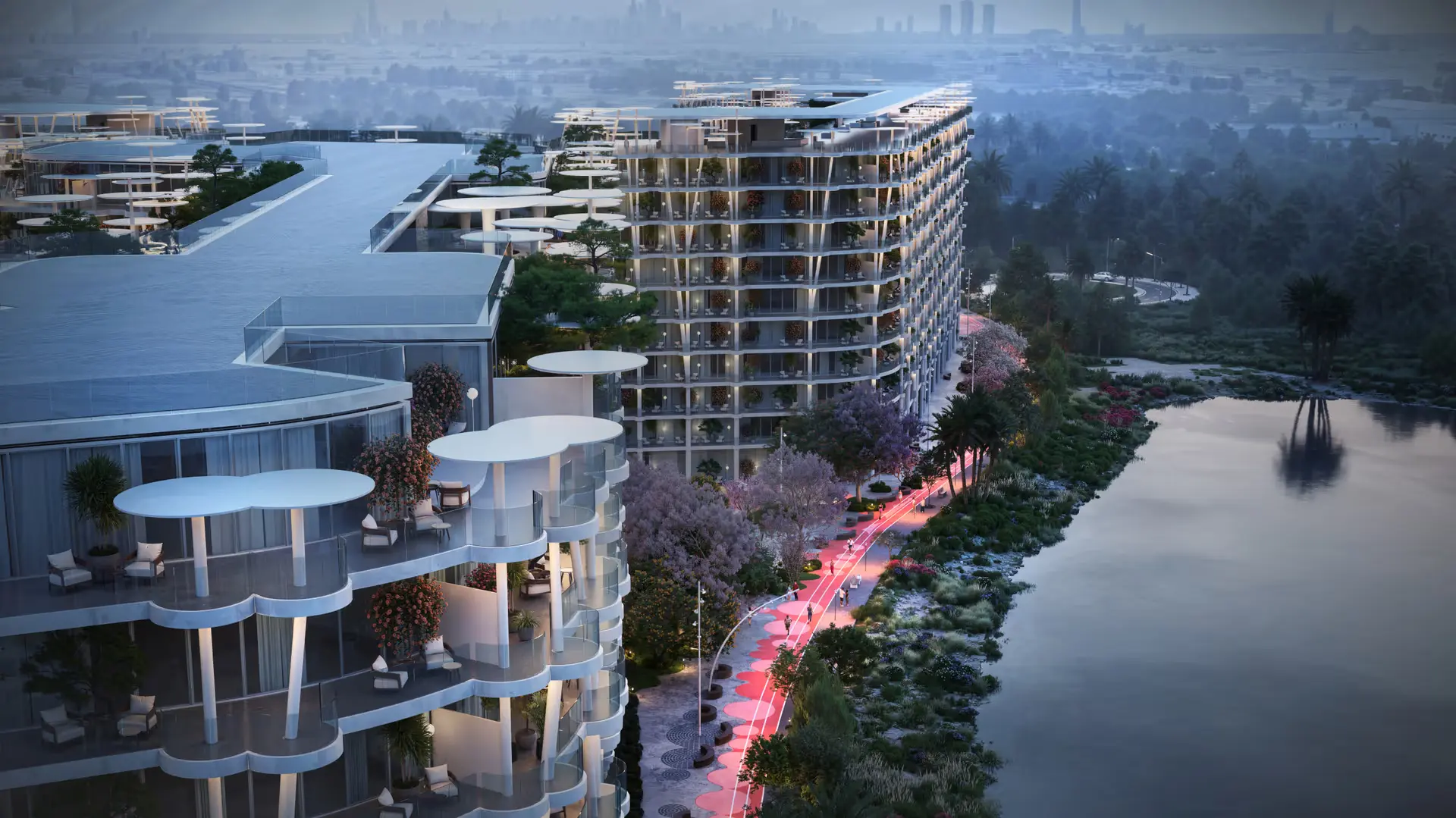
The project is described as a resort-style low-rise residential community in Falcon City of Wonders, Dubailand, with more than 50% of its masterplan dedicated to greenery and more than 50 lifestyle facilities.
Its design places gardens, courtyards, walking routes, meditation zones, jogging trails, and yoga areas within the residential environment.
This is a useful example of the difference between adding amenities and creating a lifestyle concept.
The greenery is not simply decoration.
According to HRE’s project description, the buildings and pathways are arranged around nature, while parking is placed underground to create a more pedestrian-focused surface environment.
That approach demonstrates how wellness can influence the masterplan itself.
Wellness and the Future Resident
The future resident may expect more from a property than previous generations did.
A home increasingly needs to support multiple aspects of life.
It may need to function as:
- A home
- A workplace
- A fitness environment
- A social space
- A place for relaxation
This is particularly relevant as hybrid work continues to influence residential preferences.
Developments that provide co-working spaces, business centers, outdoor areas, and wellness facilities can respond to this changing lifestyle.
SkyHills Astra, for example, includes a business center and co-working facilities alongside its wellness and recreational spaces.
The underlying idea is simple:
The residential building is becoming a lifestyle ecosystem.
Wellness and Property Differentiation
Dubai has a highly competitive residential market.
Thousands of apartments compete for buyers and tenants.
In such a market, differentiation matters.
A development can differentiate itself through:
- Architecture
- Location
- Price
- Amenities
- Brand
- Views
Wellness provides another dimension.
Instead of saying:
“We have a gym.”
A development can communicate:
“This is a place designed around how you want to live.”
That is a much broader proposition.
The Difference Between Wellness Marketing and Genuine Wellness Design
Investors should be careful.
Not every property advertised as “wellness-focused” genuinely deserves the label.
A building with a small gym and a swimming pool is not necessarily a wellness community.
Investors should ask:
- Is there meaningful green space?
- Are walking routes integrated?
- Is natural light prioritized?
- Are outdoor areas usable?
- Are wellness amenities practical?
- Are they maintained properly?
- Does the architecture support the concept?
- Is the development designed around residents?
The answer should be visible in the actual design.
Measuring Wellness Features as an Investor
Wellness can seem difficult to quantify.
But investors can evaluate it through practical indicators.
Green Space
How much usable greenery exists?
Walkability
Can residents move comfortably around the community?
Fitness
Are there multiple ways to exercise?
Social Space
Are there areas that encourage interaction?
Privacy
Are there quiet areas for relaxation?
Indoor Environment
Is natural light and ventilation considered?
Connectivity
Can residents easily access transportation and services?
Maintenance
Can the facilities remain attractive over time?
This transforms wellness from a vague marketing term into something that can actually be evaluated.
Wellness and Rental Appeal
Tenants increasingly compare properties based on lifestyle.
For example, two apartments may have similar:
- Size
- Price
- Location
But one may offer:
- A running track
- Gardens
- Fitness areas
- Co-working space
- Outdoor social areas
That additional ecosystem can influence tenant preference.
It may not automatically justify a higher rent.
But it can strengthen the property’s competitive positioning.
For investors, that is what matters.
Wellness and Long-Term Relevance
Residential trends change.
However, the basic desire for:
- Health
- Comfort
- Nature
- Community
- Convenience
is unlikely to disappear.
This gives wellness-oriented design a potentially durable quality.
The objective should not be to follow a temporary trend.
It should be to create environments that remain useful as lifestyles evolve.
How Dubai’s Future Planning Supports Wellness
Dubai’s long-term urban strategy reinforces several concepts associated with wellness real estate.
The Dubai 2040 Urban Master Plan aims to more than double green and recreational areas, increase the availability of education and health facilities, and develop connected green corridors.
It also includes five urban centers designed to support economic activity, employment, lifestyle facilities, and community development.
These initiatives demonstrate that wellness cannot be viewed only at the building level.
The city itself is evolving toward a more integrated relationship between:
- Housing
- Work
- Transportation
- Recreation
- Nature
- Services
That broader environment matters to every residential investment.
A Practical Checklist for Wellness Property
Before purchasing a wellness-oriented property, investors should evaluate:
Green Space: Is it meaningful or decorative?
Fitness: Are there practical facilities for different activities?
Walkability: Can residents move comfortably without driving?
Natural Light: Do the apartments receive good daylight?
Outdoor Areas: Are balconies, gardens, and terraces usable?
Community: Are there genuine social spaces?
Technology: Does smart technology improve convenience?
Sustainability: Are environmental considerations integrated?
Location: Is the project well connected?
Maintenance: Can the facilities remain high quality?
Target Market: Who will actually value these features?
This approach prevents investors from paying a premium simply because a project uses the word “wellness.”
Frequently Asked Questions
What is wellness real estate?
Wellness real estate is property designed around physical health, mental wellbeing, nature, social connection, comfort, and healthier lifestyles.
Is wellness real estate the same as luxury real estate?
No. Luxury focuses primarily on exclusivity, materials, services, and premium experiences. Wellness focuses on how the environment supports daily life.
Why is wellness becoming important in Dubai?
As Dubai’s population and residential market continue to evolve, residents are increasingly looking for homes that support convenience, health, nature, fitness, and community.
Does wellness increase property value?
It can contribute to a property’s attractiveness, but wellness features should be considered alongside location, construction quality, pricing, demand, and other fundamentals.
What wellness features should investors look for?
Green space, fitness facilities, walking paths, natural light, outdoor areas, social spaces, good indoor environments, and convenient access to services are useful indicators.
Is green space important in residential development?
Yes. Green areas can contribute to the visual quality, recreational value, and overall experience of a community.
Are wellness properties suitable for families?
They can be particularly attractive to families when they include safe outdoor spaces, parks, children’s facilities, fitness, and convenient access to schools and services.
Final Thoughts
Real estate is ultimately about people.
Buildings exist because people live, work, and build their lives inside them.
As expectations change, residential development must change with them.
The future of real estate will not be defined solely by how large a building is or how expensive its finishes are.
Increasingly, it will also be defined by how the building makes people feel.
Can residents walk?
Can they exercise?
Can they spend time outdoors?
Can they work comfortably?
Can families socialize?
Can people find quiet spaces?
Can residents connect with nature?
These questions are becoming part of the definition of a successful home.
Dubai’s long-term urban planning is moving in a similar direction, with greater emphasis on green spaces, sustainable mobility, integrated communities, public facilities, and quality of life.
For developers, this creates a responsibility.
For investors, it creates another factor to consider.
And for residents, it creates the possibility of a better relationship between the places they live and the lives they want to lead.
HRE Development’s approach reflects this broader philosophy.
From the wellness-focused amenities of SkyHills Astra to the nature-led concept of Sakura Gardens, HRE is developing residential environments where lifestyle is considered as part of the architecture rather than added afterward.
The future of Dubai real estate is not simply about building more homes.
It is about building better environments in which people can live.
Because the most valuable property may ultimately be the one that does more than provide an address.
It provides a better way to live.
HRE Development — Building with Purpose. Creating Places for Better Living.